
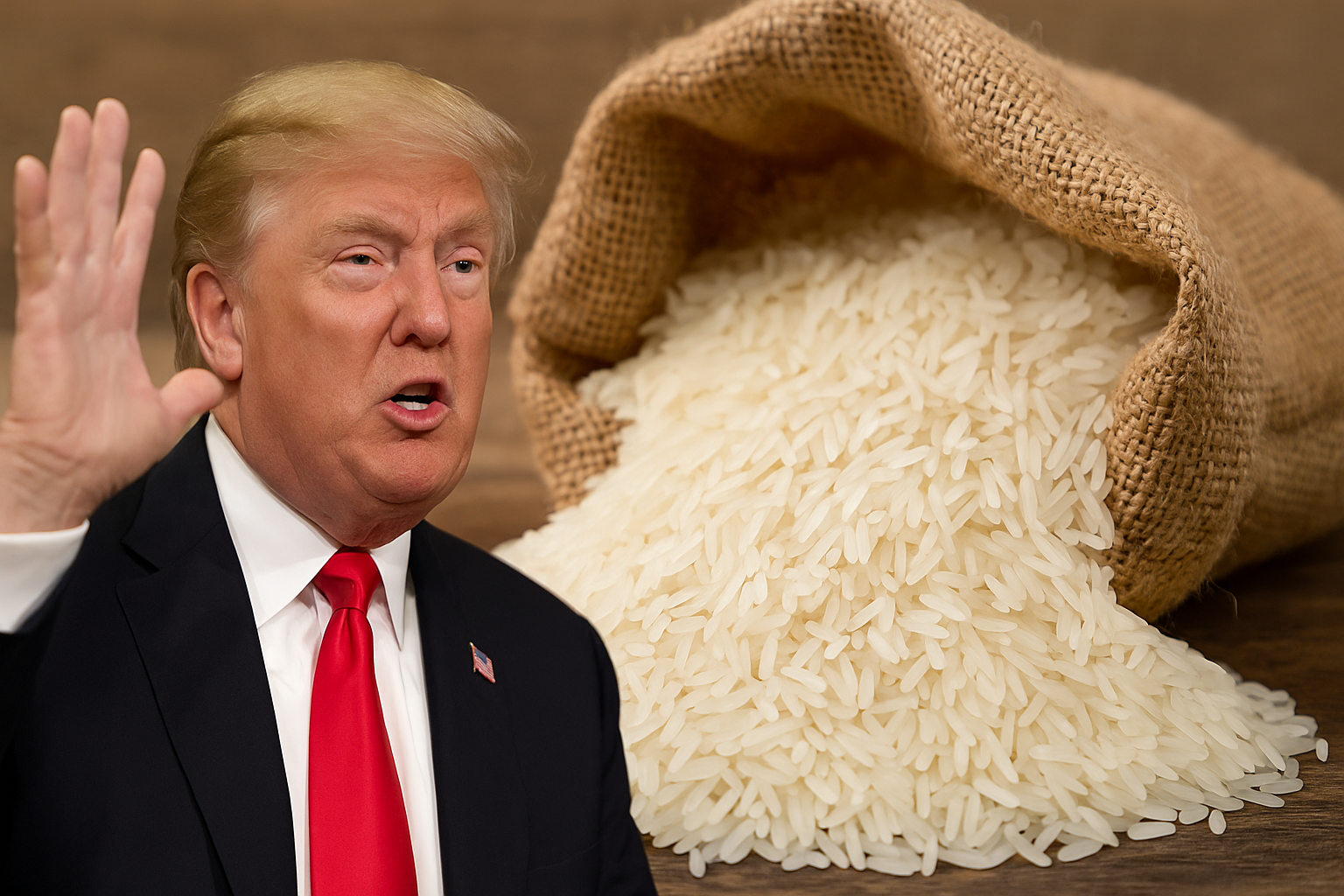
Trump’s Rice Tariff Threat: Impact on India’s Basmati Trade
US President Donald Trump’s latest warning about imposing fresh tariffs on rice imports from India, Vietnam, and Thailand has stirred concern across the global rice trade. However, Indian exporters remain confident that the impact on Basmati shipments will be limited—primarily because American consumers rely heavily on India for premium aromatic Basmati.
During FY 2024–25, India exported Basmati rice worth $337.10 million (274,213 MT) to the US, making it the fourth-largest market for premium Indian rice. Non-basmati exports were much smaller at $54.64 million (61,341 MT).
Despite existing tariffs pushing the effective duty on Indian rice to around 53%, exporters say Basmati demand in the US has remained stable. Any further tariff hike, they say, will again be passed on to American consumers, not Indian farmers.
Why Trump Issued the Threat
At a White House roundtable on 8 December with US farmers, agricultural lawmakers, and Agriculture Secretary Brooke Rollins, Trump promised to “take care of” what he described as India’s “dumping” of cheap rice into American markets.
US farmers, especially from Southern states, have long accused India of:
- Selling low-cost rice
- Distorting American crop prices
- Hurting US-grown long-grain varieties
But the data tells a different story. A Moneycontrol analysis shows:
- India’s share in US rice imports was 25.6% in 2017
- India’s share is 25.9% in 2024
Even though US rice imports doubled to $1.6 billion, India’s share remained unchanged.
Why Exporters Believe Basmati Won’t Face a Major Hit
Exporters say Trump’s comments largely target non-basmati rice because Vietnam and Thailand export only non-basmati to the US.
- US consumers buy Basmati primarily for Indian, Pakistani, Middle Eastern cuisines.
- American-grown long-grain rice cannot replace Basmati in dishes like biryani and pulao.
Ajay Bhallotia, General Secretary of AIREA, said:
“Basmati exports to the US are nearly five times higher than non-basmati shipments. Any new duty will likely affect the cheaper rice first.”
India’s Rice Export Landscape
India remains the world’s largest rice exporter, holding over 40% of global shipments.
Where Indian Rice Goes:
- Middle East (Saudi Arabia, Iran, UAE)
- Africa
- US (small volume but high value)
FY 2024–25 Overview:
- Total global exports: 20.1 MMT
- Exports to US: 3.34 lakh MT (Basmati + Non-Basmati)
- Value: Nearly $390 million (₹3,510 crore)
Understanding Existing US Tariffs
- Earlier duty: 10%
- After hikes: 40%
- Effective burden (incl. other charges): ~53%
Yet exports continued because the additional cost was passed on to American retail prices—and consumers continued buying Basmati due to lack of alternatives.
Why American Consumers Will Bear the Burden Again
According to the Indian Rice Exporters Federation (IREF):
- Basmati cannot be replaced by US-grown varieties
- Demand remains strong among South Asian, Gulf, African, and American households
- Basmati’s aroma, grain length, and texture are unique
Prices may rise in US grocery stores, but exports from India are expected to continue.
Broader Trade Implications
Indian exporters say the industry is prepared:
- Diversified global markets
- Rising demand in Europe, East Asia, Africa
- Government and trade bodies exploring alternative trade routes
Dev Garg, Vice President of IREF, said:
“India’s rice export industry is resilient. The US is important, but not irreplaceable.”
What Happens Next?
The US has not officially announced any new tariffs yet. For now, the industry expects:
Short-Term:
- No immediate disruption
- Minor price increase for US consumers
- Possible pressure on cheaper non-basmati
Long-Term:
- Depends on uniform vs. targeted tariffs
- Potential agricultural retaliation from India
Key Facts at a Glance
- India exported $337.10M Basmati to US in FY25
- US is the 4th-largest Basmati market
- Trump warned of tariff hikes
- Current effective duty ~53%
- India’s share in US imports stable since 2017
- Experts believe non-basmati will be targeted
- Basmati demand in US is strong and price-insensitive
- Any tariff hike will hit US consumers, not Indian farmers
Final Takeaway
Despite strong rhetoric, the Indian Basmati trade is unlikely to suffer significantly. American consumers—especially those who insist on authentic long-grain Basmati for biryani and pulao—are expected to absorb any tariff-related price hikes.